 Numgrove
Number Tree Puzzles: The Daily Game That Turns Factor Trees Into Fun
You've seen Wordle. You've seen the math Wordles. But there's a branch of number puzzling that nobody turned into a daily game until recently. It's called the number tree puzzle, and it grows out of one of the oldest ideas in arithmetic: the factor tree.
What is a number tree puzzle?
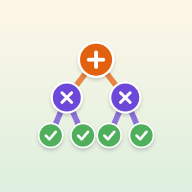
A number tree is exactly what it sounds like: a tree made of numbers. At the top sits a root number. Below it, branches split into smaller numbers, joined by an operation. In a number tree puzzle some of those numbers are missing, and your job is to fill them in so that every branch works.
The two operations you'll meet:
- A + node equals the sum of the two numbers below it
- A × node equals the product of the two numbers below it
When the whole tree adds and multiplies up to the number at the top, you've grown it. That's the whole game, and it's deeper than it sounds.
A worked example: a classic factor tree for 72
Here is the kind of factor tree you may remember from school, with 72 at the root:
        72
       /  \
      8    9      (8 × 9 = 72)
     / \  / \
    2  4 3  3    (2 × 4 = 8, 3 × 3 = 9)
      / \
     2   2       (2 × 2 = 4)
72 = 8 × 9, then 8 = 2 × 4, 9 = 3 × 3 and 4 = 2 × 2. In a classic factor tree like this, you keep splitting until only primes are left.
A number tree puzzle keeps the shape and adds a twist: branches can be + as well as ×, and the leaves don't have to be primes. A branch marked + that makes 9 might be 4 + 5 or 6 + 3, so you have to reason from the pieces you actually have, which is what makes it a puzzle rather than a worksheet.
How to play: grow today's tree
In Numgrove, the daily number tree game, new trees arrive every day at midnight UTC, one for each level:
- Seedling: three rows, multiplication only. A gentle start.
- Sapling: three rows with both + and ×, plus one spare piece that doesn't belong in the tree.
- Ironwood: four rows, + and ×, and two spare pieces. It's the ranked daily: your score is your time plus 10 seconds for every move beyond the fewest possible, and signed-in players appear on the daily leaderboard.
Playing is tactile: tap a number in the pool, then tap an empty circle (or drag it). Tap a filled circle to take the number back. If you fill the whole tree and it doesn't add up, the tree shakes: something is wrong, and it's up to you to find which branch. Undo and Reset are always there, though on Ironwood every move still counts toward your score.
Why factor trees make great practice
Factor trees are a familiar part of school math, usually in the upper elementary and middle school years, as the classic way to learn how multiplication and prime factorization work.
On a worksheet, though, a factor tree has no streak, no leaderboard and no daily ritual. Turning the same idea into a game doesn't dumb it down. It gives players, young and old, a reason to practise the kind of mental arithmetic the worksheet was aiming for.
Number trees vs. equation-guessing games
Games like Nerdle ask you to guess a hidden equation. Number tree puzzles ask you to build one. The difference matters:
- Guessing games test deduction from colour feedback.
- Tree puzzles test constructive arithmetic: you work out how the numbers fit together, not just which digits appear.
If you bounced off equation-guessing because it felt like a spelling test with numbers, trees might be your game. Same daily habit, different thinking.
FAQ
What is a number tree puzzle?
A puzzle where you fill missing numbers into a tree so that every + node equals the sum of the two numbers below it and every × node equals their product, all the way up to the root.
Is Numgrove free?
Yes. Every daily tree and unlimited practice trees are free, and it runs in your browser: no download, and no account needed to play.
When do new puzzles come out?
Every day at midnight UTC: one new tree for each level, Seedling, Sapling and Ironwood.
Are number tree puzzles good for kids?
They practise the same multiplication and factoring skills taught in school, and the daily-puzzle format adds motivation a worksheet doesn't. Children can play every puzzle as guests; accounts are for players 13 and older.
How is this different from Nerdle?
Nerdle is equation-guessing: find the hidden calculation. Number tree puzzles are equation-building: work out how the numbers fit into the tree. Different mechanic, same daily-puzzle habit.
Ready to grow one? Play today's tree free, and when you want to get faster, read our 7 number tree strategies. New to the game? See how to play or the FAQ.